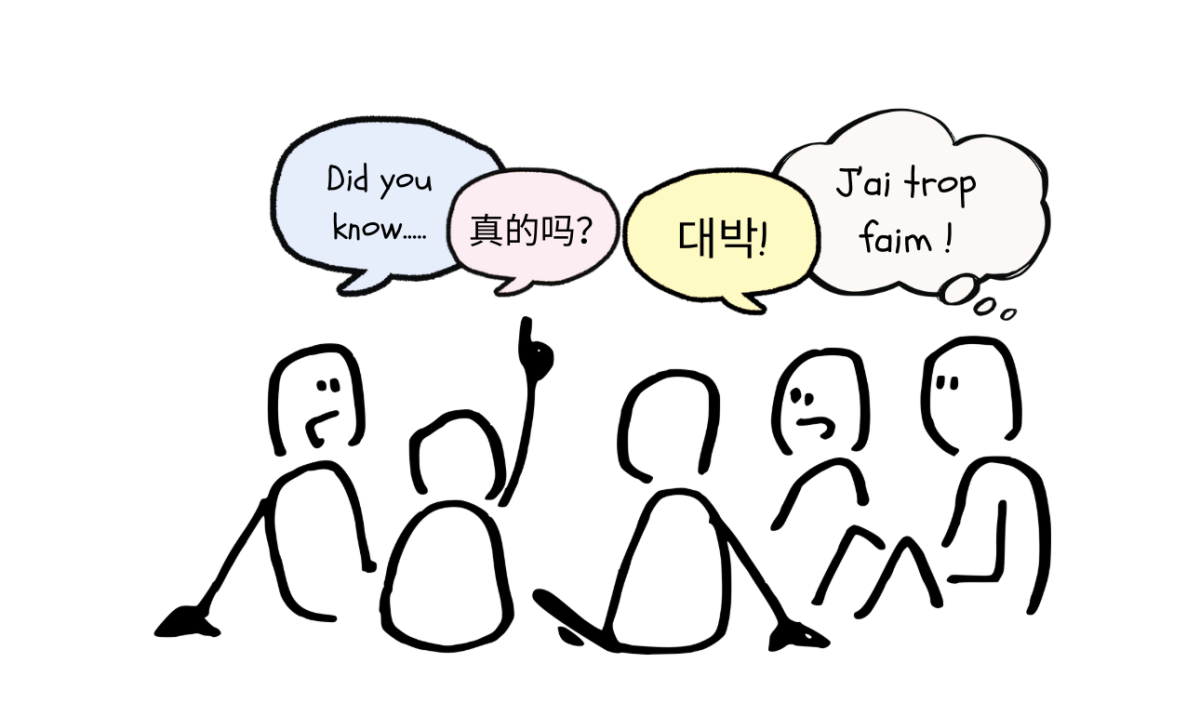



I have been at Sacred Heart for fifteen years.
It’s strange to say that out loud, as fifteen years feel like an entire lifetime. This school has been more than just classrooms and uniforms to me; it’s a home and a constant rhythm of who I’ve grown into. It’s where I’ve forged my closest friendships, made my best memories, and discovered who I am.
But lately, I’ve begun to sense the tide shifting. Things that once felt new and exciting have started to feel familiar or even small. Even the comfort that once grounded me now feels like something I might outgrow. I’ve started to sense a kind of restlessness that warns me, you’ve been here long enough. Though not a feeling of rejection, it feels as though the current is turning beneath my feet.
It is here that the word 「潮時」 (Shiodoki) comes to mind.
Translated literally as “the time of the tide,” 「潮時」 carries various meanings in Asian cultures. In Chinese, 「潮時」 means the right or favorable moment, emphasizing the moment when conditions align and it becomes wise to act. The metaphor draws on the natural motion of the sea and suggests that just as tides rise and fall in rhythm with unseen forces, so too do our opportunities appear and recede with time. To understand 潮時, it’s important to understand that timing is not merely external or mechanical, but an organic harmony between circumstance, intention, and readiness.
In traditional Chinese philosophy,「潮時」 echoes with the Daoist ideal of 「順勢而為」or “acting in accordance with the flow.” When one moves with the current rather than acting against it, it’s understood that effort becomes effortless; actions align with natural progression. As the saying goes:
「 把握潮時而行,事半功倍」(Act when the time is right, and you’ll achieve twice the result with half the effort.)
Across East Asia, similar interpretations appear. According to the Agency for Cultural Affairs, the word in Japanese is used to describe the moment when something has run its course: 「そろそろ潮時だ。」(It’s time to move on).
Interestingly, when the agency had surveyed the public on this topic in the 2012 Public Opinion Survey on the Japanese Language, it found that only 60% of respondents understood the original meaning of “the right or favorable time,” while over 36% believed that it meant “the end of something”.
This misunderstanding, the agency explains, comes from modern usage where, in everyday life, the word「潮時」 often appears in contexts like retirements or farewells. For example, a politician stepping back after years in office or an athlete retiring with 「今が潮時だと思った」 (I thought this was the right time). It is surprisingly even found in romantic advice columns where various writers talk about “a relationship’s shiodoki,” meaning the time to break up.
As a result, over time, these contexts have colored the word with the sense of “ending.” However, as the Agency for Cultural Affairs points out, this is not necessarily what it means. In the true original sense, 「潮時」 is not an ending but rather the perfect alignment. Marking the moment where conditions come together naturally, it is the period where acting feels effortless; when things flow like an outgoing tide meeting the moon.
In literature, this nuance is especially clear. The 1935 essay 「海水浴」(“Seaside Bathing”), by Terada Torahiko, had described boats travelling from Kochi to Tanezaki taking hours “even when the tide was good.” Here, 「潮時」 is literally referred to as tidal timing; moving when the sea is allowed. In 1941, 「椰子林の巻」(“The Palm Grove Chapter”) by Nakazato Kaizan, the usage of「潮時」 did not refer to the sea but rather the moment when the main character had entered into a secret meeting where outsiders were not permitted. Here, 「潮時」meant the right moment to enter a meeting—not an ending, but an opening. It is through these examples that we are reminded that 「潮時」 is about timing and harmony, not closure.
This subtle evolution in the meaning of 「潮時」also reveals something larger about how language reflects a culture’s relationship with time and change. In Japanese, as well as in Chinese,
「潮時」embodies an awareness of timing as cyclical and relational. Yet in English, time is often perceived as linear and more decisive, marked by beginnings and endings rather than flows and transitions. It is this contrast that has made me think about how differently languages can frame the rhythm of life itself. While English expressions like “overstaying one’s welcome” often imply missing the right moment to leave, 「潮時」gestures toward the art of seeing when it is time—not necessary to end, but to move, shift, or begin anew.
As seniors, we find ourselves standing at the edge of a shoreline, looking out towards the same horizon, yet feeling the pull of the tide in different ways. For some, the current is strong and certain, urging others to go forward into something new. They are ready to go and see what lies beyond the familiar waves of Sacred Heart. For others, the tide feels gentler, or maybe even still. There’s a certain comfort in staying, in holding onto what we know.
The tide doesn’t pull everyone at once. It ebbs and flows in its own rhythm, reminding all of us that growth doesn’t happen on the same schedule for everyone. Some are drifting toward the open sea while others are still gathering courage to take their first step into the ocean.
That’s what 潮時 means to me now—not just the right time to leave, but the grace to recognize when your time has come. For me, it’s about trusting the tide, whether you’re ready to ride the wave or still finding your footing on the sand.
So I’ll move on, carrying with me everything this place has given me: from the nervous laughter of our first assemblies to the familiar rhythm of homeroom mornings, the countless pages of yearbooks recording our growth, and the friendships that have grown deeper with each passing year.
After fifteen years at Sacred Heart, I know that my tide is shifting. The waves that once carried me here are gently pushing me forward. It’s bittersweet, leaving a place that has been both an anchor and a compass. But I’ve come to understand that leaving Sacred Heart isn’t an ending, but an alignment — the right time, the tide turning in my favor.
So I’ll move with it, carrying with me everything this place has given me.
Connection. Growth.
And the courage to continue changing with the tide.