


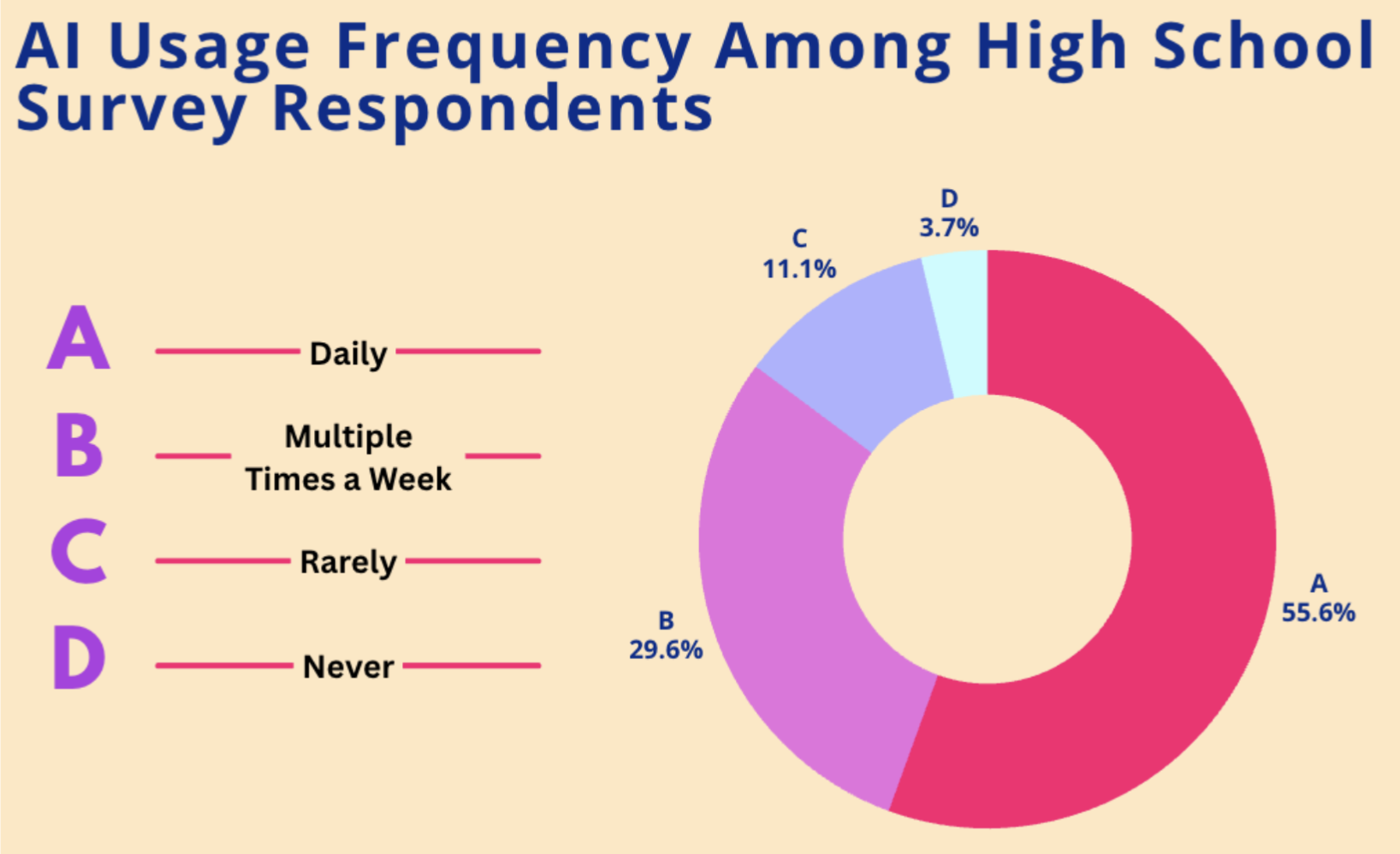
Unconsciously, AI has slowly crept into our daily routines. At the International School of the Sacred Heart (ISSH), a survey of 60 middle and high school students and faculty revealed just how quickly this shift is happening. Thirty-three individuals reported using AI platforms multiple times a week, and among high school respondents, 78% reported using AI daily, mainly for brainstorming ideas, explaining concepts, and drafting emails.
Indeed, AI is a useful tool: one that can minimize our time and maximize our efficiency. Therefore, it may seem rational to rely on these tools. As one high school student shared in the survey, “I find AI very helpful because it saves me a lot of time.” But as AI becomes more embedded in our everyday routines, what might we be losing in exchange for this efficiency?
Researchers claim that overreliance on AI platforms could negatively impact crucial skills such as communication and emotional awareness by “eroding our capacity for independent thought, decision making, and autonomous action.” Ironically, the very tools designed to make communication more efficient may ultimately weaken our ability to communicate independently. While these skills are often overlooked in favor of technical skills, they are the foundation for nearly every aspect of human interaction.
Students already notice AI’s side effects
Many students at ISSH themselves are beginning to feel the effects of relying on AI tools. Several ISSH respondents expressed concern that their independence and confidence are gradually weakening.
As one high schooler commented in the survey, “I think I have lost some confidence in my own email-writing skills as I have increasingly relied on AI to draft them for me.” Another student shares a similar concern: “My basic abilities to think for myself and write independently are diminishing.”
These comments reflect a broader phenomenon researchers call “agency decay.” Much like muscles that weaken if we don’t exercise regularly, using AI in place of critical thinking can erode our capability to reason and communicate efficiently.
The impact of “agency decay” extends beyond the deterioration of our ability to communicate and think, undermining users’ sense of confidence and motivation. This effect emerges because completing tasks quickly with the help of AI can generate a false sense of confidence and satisfaction. When these tools become unavailable, however, users’ confidence drops, not due to a lack of ability, but because they have lost trust in their own skills. Without the quick sense of satisfaction that comes from finishing tasks rapidly with AI, the slower pace can also feel discouraging and less rewarding. This lack of confidence creates a sense of discomfort that pushes users to turn back to AI for reassurance, reinforcing a self-perpetuating cycle of dependence on AI platforms.
Students’ concerns about what’s most at risk
Survey responses from ISSH students highlight two main areas of concern regarding AI use: the decline of creativity and independent decision-making, and the weakening of communication and social skills.
Among 80% of survey respondents at ISSH who acknowledged the risks associated with relying too heavily on AI tools, 81% raised concerns about AI’s role in the decline in creativity and in our ability to make decisions with human judgment rather than relying on AI.
A high school student at ISSH shared her concerns, noting that “creativity and individuality can be impacted if people continue relying on AI rather than thinking for themselves.” Without individuality and a sense of identity, “people become less able to make informed decisions on their own, which could lead to personal, social, and political issues.”
The students’ concerns align with extensive research. Research on AI in the Workplace conducted in 2024 shows that effective AI integration relies on human factors, particularly strategic decision-making. In addition, to address current limitations such as the “inability [for AI platforms] to solve complex problems,” individuals must hold skills such as “critical thinking” and “adaptability.”
Ironically, as AI tools become more advanced, research suggests that human cognitive skills, such as critical thinking, become more essential. Yet excessive reliance on AI risks eroding the very skills required to successfully adopt and implement AI platforms in the future.
While creativity was the greatest concern for students at ISSH, it wasn’t the only major issue identified in the survey. Communication and social skills came in a close second, with approximately 74% of respondents calling attention to the potential for these AI platforms to erode our emotional and social intelligence. As a high schooler at Sacred Heart noted: “I worry AI might weaken social skills, as people have become more engrossed in speaking to AI instead of other people.”
Research backs up student concerns
Students’ concerns are reinforced by research published in Cognitive Research: Principles and Implications. The study warns that when AI is used routinely, “even well-trained experts may gradually lose their cognitive skills.” Such tools can erode fundamental human skills in ways that “prevent experts and learners from recognizing [their] deleterious effects.” As a result, many users become unaware of their growing dependence on AI, relying on it to function efficiently while gradually losing confidence in their ability to complete tasks independently.
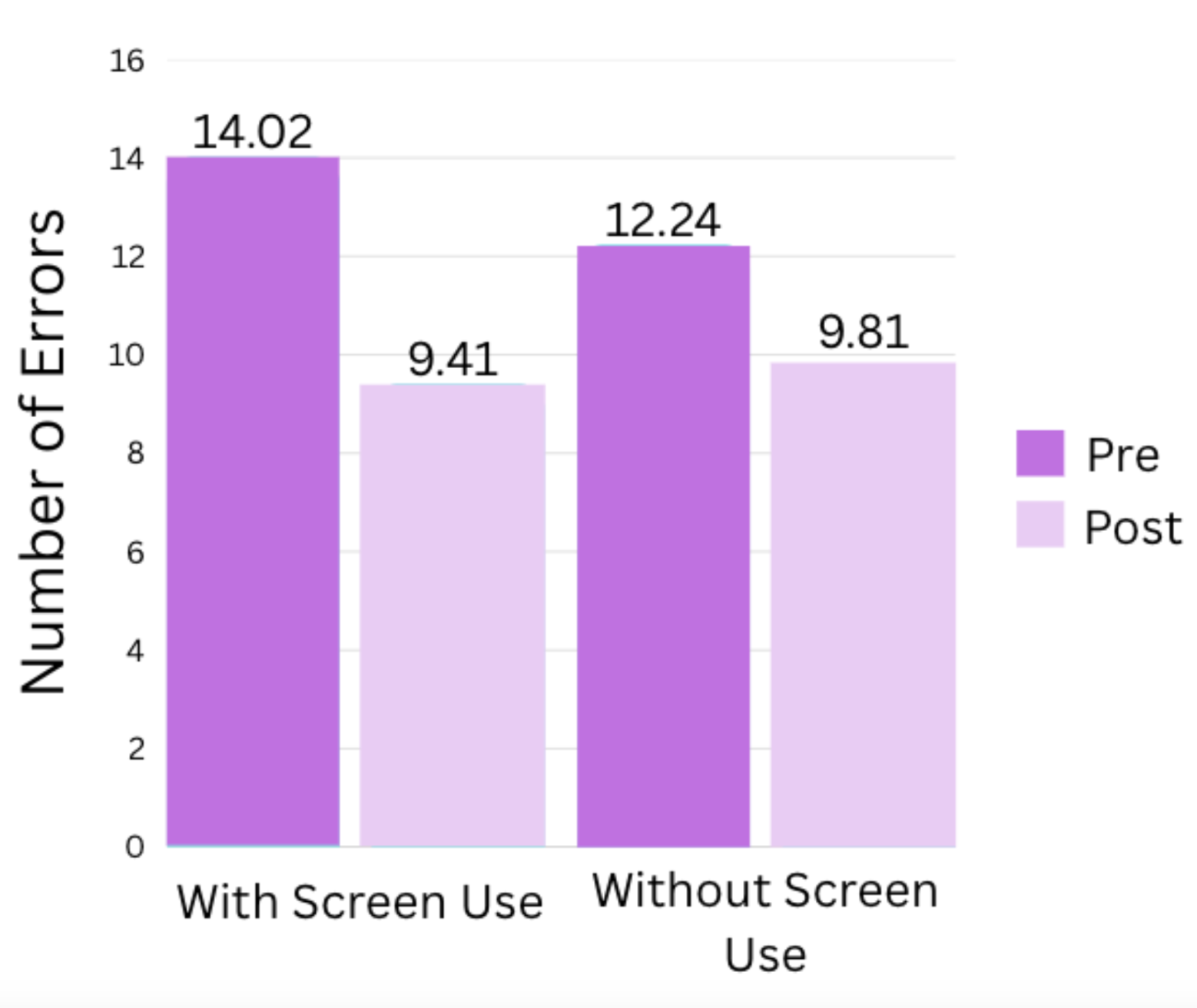
Echoing students’ worries about AI’s detrimental effect on social skills, a study conducted at the University of California Los Angeles (UCLA) noticed that children who spent five days at a camp without access to digital media demonstrated significant improvement in their ability to read facial expressions and interpret nonverbal emotional cues, compared to a control group of peers who remained at home and continued using media devices, as shown by the chart on the left. Students at ISSH confirm this trend, as one student said “my dependence on AI has streamlined my writing, but it has also weakened my ability to communicate independently.”
As AI-driven platforms become increasingly integrated into digital media platforms, this issue is likely to intensify. In fact, research suggests that “digital consumption will move at the pace of artificial intelligence.” AI tools provide users with personalized experiences that not only improve user satisfaction but also increase the time spent on digital media. They also allow media companies to “gain deeper insights into individualized user behavior and preferences,” and optimize their content to increase time spent by users on their platforms. Much like communication, emotional intelligence develops through in-person social interactions. They cannot be learnt from a screen at home. So, increasing integration and reliance on AI and digital media in turn causes users to become less sensitive to emotional cues and develop lower emotional intelligence.
In fact, a study conducted on the Importance of Emotional Intelligence in the Workplace demonstrates that employees with higher levels of emotional intelligence are “better able to cooperate with others, manage work-related stress, solve conflicts within workplace relationships, and learn from previous interpersonal mistakes.”
Scholars specifically state that if an individual doesn’t have certain emotional qualities, they are “unlikely to succeed” in the workplace, “no matter how many degrees or other on-paper qualifications” they hold. The role of emotional intelligence extends beyond simply managing smooth working relationships. It also helps “boost self-awareness, self-control, motivation, empathy and social skills,” crucial characteristics that foster mutual trust and build the foundation for a strong, healthy relationship.
Who is most at risk?
Compared to teenagers, adults are less affected by this growing dependence on AI, as they have already developed critical thinking and social skills prior to the widespread use of AI tools. In other words, the generation growing up alongside AI may be most affected by AI’s detrimental effects.
While the increasing presence of AI impacts all users, students are particularly vulnerable to its detrimental effects, as adolescence is a crucial period for developing communication habits, emotional awareness, and independent thinking skills.
If AI quietly replaces opportunities to practice these skills, students may gain short-term efficiency but lose essential abilities that cannot easily be rebuilt later. A student at ISSH noted that “AI prevents people from trying to think of solutions to problems themselves.” Instead, people just “mindlessly input questions, even simple ones,” into AI platforms such as ChatGPT.
Finding a solution to minimize AI’s harm
One student at ISSH explained that she often uses AI to “complete simple tasks” so she can “save a lot of time that [she can] spend on more important tasks.” At first glance, this seems logical. But, how do we actually define which tasks are important and which are not?
Most students view homework as less important than assessments because it carries a lower weight in grading. Yet this overlooks the purpose of such tasks. Homework not only contributes to preparation for assessments but also helps students develop skills such as problem-solving and independent thinking.
When AI is used to complete these ‘unimportant’ tasks, students may gain short-term efficiency, but at the loss of opportunities to build the very skills needed for long-term success. As a result, the distinction between “important” and “unimportant” tasks becomes increasingly blurred.
This blurry line of distinction reflects the broader issues surrounding the use of AI to achieve immediate convenience rather than long-term development. At ISSH, the majority of the surveyed students and faculty already rely on AI multiple times a week. Research conducted by the UK government in January of 2026 shows that 73% of the public have used AI in their day-to-day life. These numbers reinforce how AI platforms are already strongly embedded in our lives. As a result, avoiding AI platforms entirely is neither realistic nor necessary.
Therefore, to address this challenge, researchers emphasize the need for a balance between artificial intelligence and natural intelligence: ‘Hybrid Intelligence.’ AI literacy allows recognition of the limitations of AI systems with human judgment, such as being fully aware of the biases and limitations of AI-generated responses and solutions. Natural intelligence includes not only critical thinking skills, but also understanding of group dynamics and societal norms that hinder our ability to “empathize, innovate, … and collaborate.”
One way ISSH attempts to reach Hybrid Intelligence is by encouraging responsible usage of AI platforms through ‘Learning Mode’ so that students can use them to support their learning without becoming overly dependent on them. Under the ‘Learning Mode,’ AI tools ask guiding questions to assist students in thinking through problems themselves rather than simply providing straightforward answers.
In addition, while ISSH does not ban specific AI platforms, the school encourages students to use the official school-approved AI platform, FLINT. Through FLINT, teachers can monitor how students use the platform and ensure it is used as a learning aid rather than a shortcut to completing assignments.
While fully eliminating the use of AI platforms is nearly impossible as they have already been incorporated into core parts of our routines, it’s crucial to establish conscious habits that help maintain a stable balance between artificial and natural intelligence. Doing this ensures that productivity and convenience do not unconsciously replace our creativity, critical thinking, and ability for genuine human connections.


