

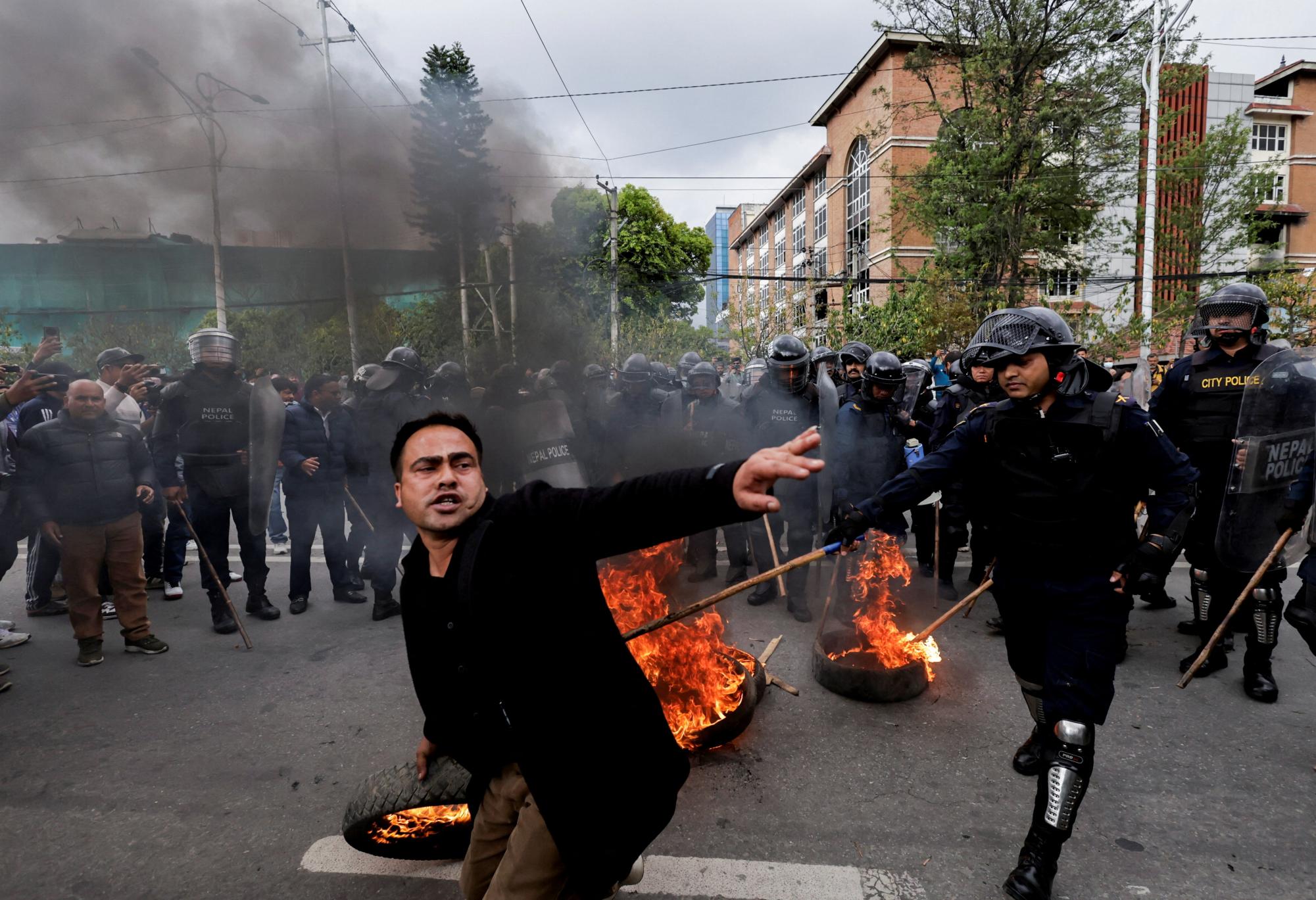

Smoke loomed above Kathmandu as crowds pushed through police barricades toward the country’s most powerful government buildings. Shattered glass covered the streets surrounding the Federal Parliament complex, and flames engulfed offices —the very offices that had long symbolized Nepal’s political authority.
What had begun days earlier as a digital movement had spilled fully into the streets.
The immediate catalyst in 2025 was the government’s enforcement of digital regulations, a direct attempt to tighten control over online speed. Under new provisions introduced through amendments to Nepal’s Information Technology and media governance framework, social media platforms operating in the country were instructed to register locally, appoint in-country compliance officers, store certain categories of user data upon request, and remove any content flagged by authorities within strict time limits. Officials warned that failure to comply would result in fines, criminal liability, or outright bans.
The Ministry of Communication and Information Technology framed the measures as necessary to combat misinformation, cybercrime, and content deemed harmful to national unity and social harmony. However, many figures—journalists and digital rights advocates—argue that the regulations’ language is intentionally broad and vague, granting the state significant discretion over what constitutes objectionable speech. Human Rights Watch and Reporters Without Borders had previously cautioned that Nepal’s evolving cyber laws risked being used to silence dissent rather than solely regulate harmful content.
According to reports by The Kathmandu Post and BBC News, the government issued ultimatums to major social media companies, which required compliance within a fixed deadline or face suspension. Although few platforms entered negotiations, the majority resisted provisions on the basis that they were incompatible with global content moderation standards and user privacy commitments. What followed was not a quiet policy dispute, but a rapid shift in public response. Young Nepalis heavily rely on digital platforms for both employment and expression, making the threats of bans especially alarming.
What had initially been a technical policy debate among legal experts quickly transformed into a nationwide mobilization, fueled by something that at first glance seemed almost trivial: hashtags. Within days, hashtags calling for transparency and constitutional safeguards surged across Nepali social media, with the most viral one being “#bolnadesarkar (बल्न दे सरकार)”, which translates to “let us speak, government”. Some slogans commonly found on signs during protests also include “जब नेताका छोरा-छोरीहरुको भविष्य चम्किलो छ, हाम्रो भविष्य कहाँ छ?”, translating to “when politicians’ sons and daughters have a bright future, where is ours?”. For a generation that had grown up online, the proposed restriction was not merely administrative reform; it was an act of silencing.
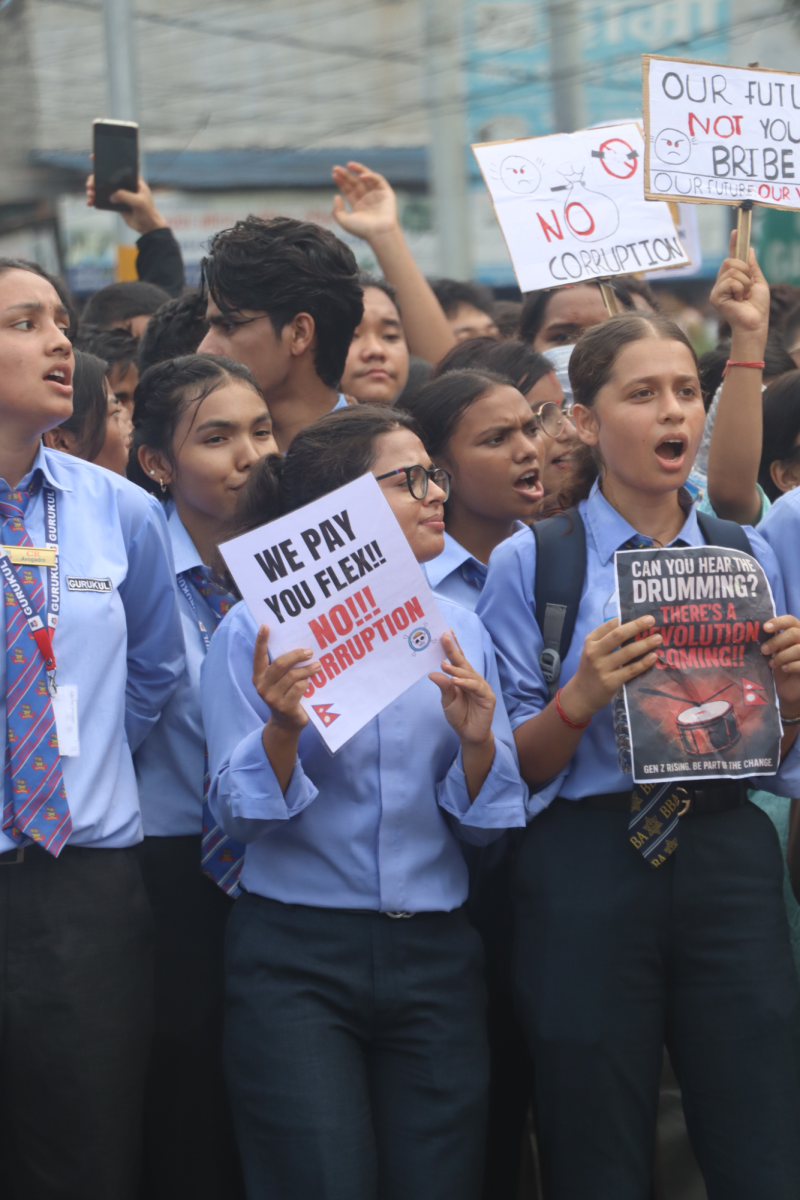
Unlike previous movements centered on empowering democratic structures or challenging monarchy-era institutions, the 2025 protests were driven by distrust of the entire political establishment. Simply put, young Nepalis had reached a breaking point. The demonstrations were not anchored in a single political opposition party nor did they rally behind an alternative leader; instead, they reflected accumulated and collective frustration with recurring patterns: corruption, opaque governance, and limited accountability. This was not a movement intent on replacing one administration with another—it was a rejection of a system many believed had failed to reform itself and support the people it claims to represent.
The flames that engulfed Nepal’s government buildings did more than damage architecture. Inside were thousands of paper files and administrative records, many of which only existed in physical form. As offices burned, so did fragments of the state’s bureaucracy, revealing how fragile Nepal’s institutional infrastructure had become. State infrastructure was physically damaged, and the consequences were irreversible. The destruction was not only physical, but also profound: exposing the vulnerability of a system that had long struggled with transparency and accountability, a reality underscored in reporting by The Kathmandu Post.
The violence quickly spread beyond the parliament compound. Protesters stormed the government’s administrative center at Singha Durbar, a historic palace complex that houses the offices of Nepal’s prime minister and numerous ministries. Protesters set sections of the complex ablaze while targeting administrative departments that housed critical government records. Nearby, demonstrators forced their way toward the Supreme Court of Nepal, where clashes erupted, all while coordinated attacks spread across Kathmandu, with fires breaking out at the residences of senior political leaders, according to Associated Press and Reuters coverage of the unrest. What unfolded was no longer a contained protest, but a rapid unraveling of state control across the capital.
The unrest did not stop at government offices. Protesters targeted the private homes of the country’s most powerful figures: Prime Minister K.P. Sharma Oli in Baluwatar and properties linked to former leaders such as Sher Bahadur Deuba and Jhala Nath Khanal, with The Guardian reporting that several residences were set on fire or vandalized as protests escalated. The protest against governance and corruption transformed into something far more personal: a confrontation with the individuals seen as responsible for decades of systemic failure and inequality.
This targeting of private homes marked a critical turning point. It signaled that public anger was no longer confined to institutions or policies, but had escalated into a rejection of the political elite themselves. For many young protesters, these homes were not just residences but were symbols of entrenched privilege, nepotism, and a system perceived to only benefit the select few while leaving an entire generation behind.
Earlier that day, the confrontation had already turned deadly. As tens of thousands gathered outside the Federal Parliament building in the New Baneshwor district, riot police fired tear gas, water cannons, and eventually live ammunition at protesters attempting to breach the compound, with clashes beginning around midday local time, according to reporting from the Human Rights Watch on the use of force during protests. Those killed were primarily young demonstrators — many in their late teens and early twenties — who had gathered at the frontlines of the march, while hundreds more sustained injuries ranging from rubber bullet wounds to severe trauma caused by crowd dispersal tactics. Witness accounts described protesters collapsing amid the chaos as medics and volunteers attempted to carry the injured away from the barricades. The young demonstrators killed at the frontlines of the movement underscored the generational stakes of the uprising.
Even as violence escalated on the ground, the confrontation was never confined to the streets.
As protesters clashed with police outside government buildings, another front of the uprising was unfolding online. Within minutes, livestreams from demonstrators began circulating across TikTok, Instagram, and X. Videos of crowds breaching barricades and chanting slogans spread rapidly across Nepali social media, drawing millions of views and transforming a domestic protest into a global spectacle, as described in coverage by TIME Magazine on the role of social media in the protests. For Gen Z organizers who had spent days coordinating demonstrations through hashtags and group chats, the internet was not merely documenting the protest – it was amplifying it. The very same digital platform that had mobilized the movement now ensured that its escalation could neither be contained nor ignored.
Yet as the demonstrations escalated, the state itself began to fracture. Cabinet ministers resigned, members of parliament abandoned their parties, and political leadership quickly lost control of the situation. Within hours, Prime Minister K.P. Sharma Oli announced his resignation, stating he would step down in order to allow a political solution to the crisis.
With civilian authority collapsing, the military moved to stabilize the capital. Units of the Nepalese Army were deployed across Kathmandu Valley, securing key infrastructure and evacuating political leaders from threatened residencies. Armored vehicles were stationed along major roads leading into central Kathmandu, and checkpoints were established around key government zones, signaling a rapid shift from civilian policing to military control. Tribhuvan International Airport was temporarily placed under military control as authorities attempted to prevent senior officials from fleeing the country amid the unrest, according to Reuters reporting on the security response. The rapid transition from civilian governance to military oversight highlighted the extent to which state institutions had lost their ability to manage the crisis — and the country.
The military’s involvement carried a different public perception than that of the police. While the Nepal Police had long faced accusations of corruption and political interference, the army historically maintained a reputation as one of the country’s more trusted national institutions, as noted in multiple analyses by Human Rights Watch and regional reporting outlets. For many Nepalis watching the crisis unfold, the deployment of the army signaled both the severity of the unrest and the possibility that order could still be restored without a full collapse of the state.
In the days that followed, the momentum of the streets gave way to the uncertainty of transition. With the prime minister gone and parliament effectively paralyzed, a temporary leadership structure began to take shape under former Chief Justice Sushila Karki. Unlike previous leadership transitions negotiated entirely within political parties, Karki’s appointment reflected significant pressure from the protest movement itself. Many of the young organizers who had driven the demonstrations publicly supported her role as a neutral caretaker figure capable of overseeing reforms and restoring institutional stability.
The protests succeeded in forcing political change, but they also left Kathmandu marked by what it took to get there— government buildings burned, dozens dead, and a political system abruptly stripped of its authority. What had begun as a demand to be heard evolved into a confrontation that reshaped the country’s leadership in a matter of days.
Yet even as the immediate crisis subsided, the deeper challenge remained unresolved. Removing those in power had proven possible. Rebuilding what comes next would be far more complex.


