

















































Despite the number of colleges that claim to be “test-optional,” the pressure surrounding standardised testing remains deeply ingrained in Sacred Heart. If colleges are truly SAT-optional, why have 86% of our student body reported feeling it is mandatory?
Until the COVID-19 outbreak in 2020, the SAT and ACT were widely required for college admissions. However, with testing centres shutting down due to the global quarantine policies, students were unable to sit the exam. Practically overnight, hundreds of universities adopted SAT-optional policies. College admissions officers initially welcomed this new enforcement. They acknowledged that standardised tests aren’t completely equitable in measuring student ability, particularly because of differences in academic subjects beyond English and Math and disparities in household income.
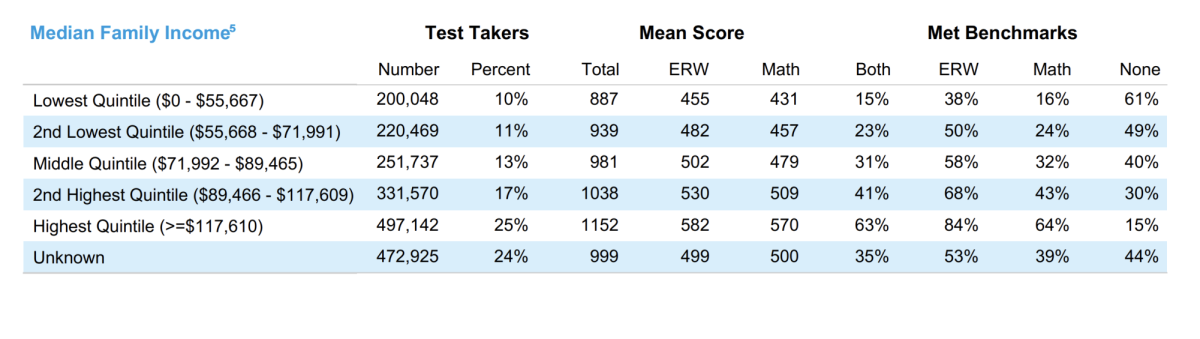
According to FairTest, a nonprofit organisation that researches standardised testing, SAT scores often reflect household income and access to these tests. In fact, students from families with incomes over $200,000 score, on average, more than 300 points higher than those from families with incomes under $20,000. This highlights how access to tutoring, test prep, and academic help significantly impacts scores.
However, as the pandemic fades into a chapter in the history books, many universities, especially Ivy League Institutions, are quietly retracting their test-optional assurances, leading to a crescendo of SAT-focused tumult. Schools such as MIT, Harvard, Brown, and Johns Hopkins have announced that their upcoming admissions will now require SAT and ACT submissions, sparking renewed anxiety and questions.
Though these standardised tests reflect inequity, education journalist Jeffery Selingo, author of Who Gets In and Why, elucidates why colleges are reintroducing them. He reports that standardised testing is a convenient way for admissions officers to reduce uncertainty when accepting students. Selingo reveals that students who submit scores to test-optional schools are often accepted at higher rates, not because scores are directly linked to acceptance, but because they help officers validate college readiness among a plethora of impressive applications.
The contradiction between the acknowledged inequity of standardised tests and their continued influence on admissions officers has left many students unsure what “SAT-optional” truly means. Former college counselor at Sacred Heart, Ms. Kelly Braun, now working as a college consultant in Idaho, USA, notes that part of this disorientation stems from the fact that “test-optional does not have only one definition.” Each university and country interprets the policy differently. While some institutions treat SAT submissions as a genuine choice, others may view absent scores as a disadvantage in the application process. In some cases, universities have broadened their definition of “testing” altogether, accepting a range of academic test results, such as AP, IB, or A-Level exam results, alongside – or in place of – SAT/ACT scores. This inconsistency makes it progressively difficult for students to understand what is actually being evaluated.
Admissions Consultant Kazma Iwasaki from Tokyo Academics highlights a critical distinction between two policies that students often overlook: SAT-optional and SAT-blind. Though these terms are frequently conflated, “test-blind” is a strict rule where standardised test scores are completely omitted, regardless of whether a student includes them in their application. This ensures applicants are evaluated solely on GPA, extracurriculars, essays, and letters of recommendation. The University of California is a primary example of this enforcement, in which admission officers do not consider SAT/ACT scores in their deliberations.
Meanwhile, “test-optional” policies empower applicants to decide whether to submit their scores. While this approach may give students more flexibility, Iwasaki notes that there is a “greater likelihood that they’re going to take that into consideration.” In practice, these policies often obscure the role of test scores altogether, leaving students uncertain about whether the choice is sincerely optional.
For example, Jeremiah Quinlan, Yale’s dean of undergraduate admissions, admitted on a recent podcast that he has become increasingly suspicious that Yale was not “being honest about the reality of our admissions process to students and parents,” noting that the university was “denying 98% of the students who are applying without test scores.” Additionally, Yale University has acknowledged that students who submitted test scores were admitted at a rate three times higher than those who did not.
Cornell University’s internal research revealed that even with constant additional variables, “submitting test scores significantly increases the likelihood of admission [to its] test-optional colleges.” Amid these findings, universities continue to shroud their use of submitted SAT/ACT scores, leaving students to navigate an opaque system. For example, Duke University, one of the few top 10 national schools that have maintained SAT-optional policies, explicitly stated that “choosing not to have SAT or ACT scores considered will not impact your admissions decision.” However, their 2023 fall undergraduate admissions statistics reveal that nearly 50% of new enrollments submitted SAT scores, and another 30% submitted ACT scores.
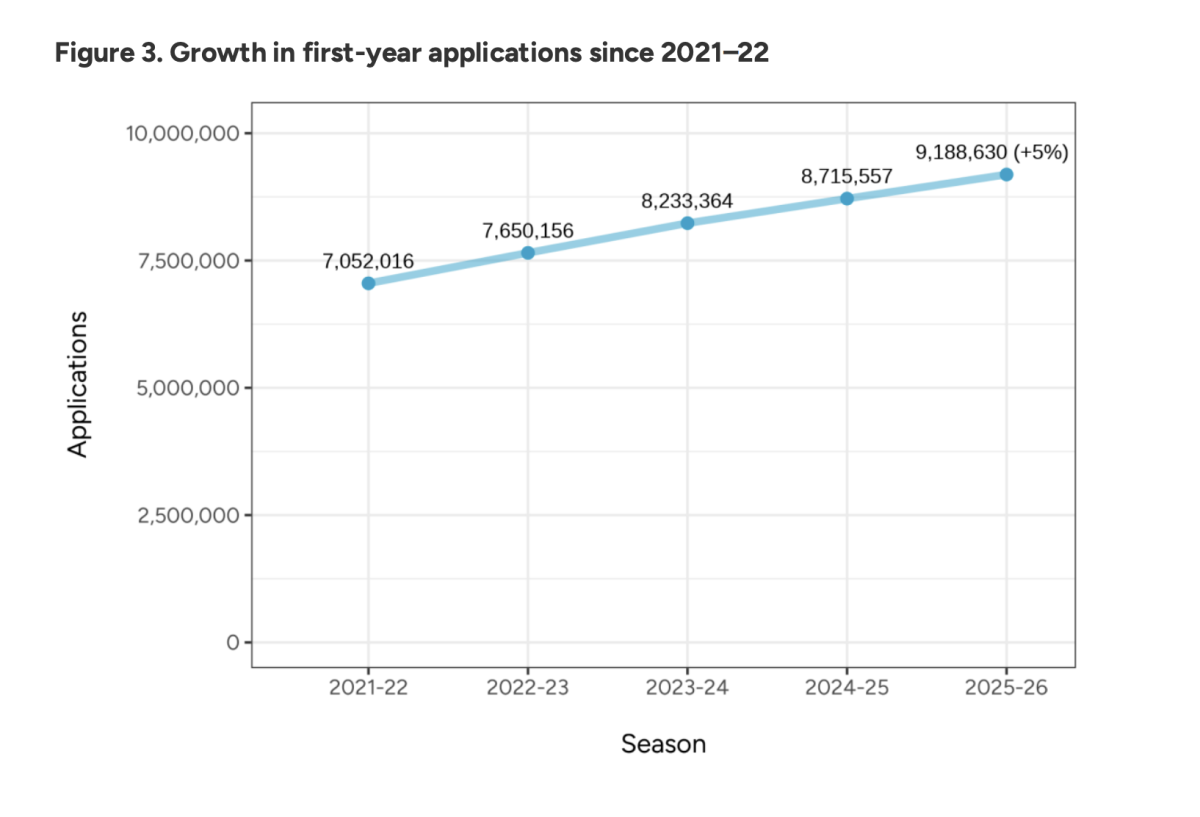
This lack of transparency adds further pressure to an already strained system, where Iwasaki points to a larger cycle fueling anxiety. While application numbers steadily rise, this increase is not solely driven by more students applying, but also by students applying to a greater number of colleges. Data from the Common App’s February 2026 Deadline Update show that while the number of first-year applicants increased by 2%, the total number of applications rose by 5% – reaching over 9.1 million in the 2025-26 cycle. This growth stems from a 3% increase in the average number of applications per student, indicating that the number of applications has grown faster than the number of applicants themselves. Due to this, acceptance rates have inevitably declined – not because of drastic selectivity, but because these institutions cannot expand enrollment at the same pace. As a result, an illusion of unattainable acceptance rates is heightened. This cycle continues as students respond by applying to even more schools, further weighing down acceptance rates and perpetuating the very pressure they react to.
As this cycle intensifies, students must make strategic decisions that most benefit their applications – one of the most significant being the submission of SAT/ACT scores. Our college counsellor, Ms. Sin, often advises students based on a college’s “middle 50%” SAT range (25th to 75th percentile), as it varies by school. “If a student’s score falls right in that middle range, I usually recommend submitting it,” she said. “But if it’s closer to the lower end and the student has strong grades, it may actually be better not to.” She emphasises that test-optional does not mean test-irrelevant. “It’s never one-size-fits-all…It depends on the school, the major, and how that student performs within their cohort.”
Building on this, senior Tuoya C. (‘26) has recently launched an SAT-tutoring program, aimed at helping international students maximise their scores. She explains that universities appear to expect higher SAT scores from international students, as they are often perceived as having greater access to academic support or as being gauged against a more competitive global pool. Drawing on her own application experience, she cautions that even test-optional institutions still place considerable weight on standardised test scores, particularly for students studying abroad, and encourages students to aim for the strongest performance possible.
College consultant Ms. Braun emphasises that there is seldom a single “right” answer when it comes to submitting SAT scores. Rather than following a universal rule or succumbing to peer pressure, students need to ask themselves: Do my test scores actually strengthen my application as a whole? She emphasises that “context is key when it comes to college applications,” referring not only to a student’s profile – their grades, courses, extracurriculars – but also to how different each university assesses their applicants. In a climate of conflicting priorities, Ms. Braun ultimately urges students to look beyond external noise and construct applications that prioritise their individual excellence.