
























One loss and it’s all over. The spring Japanese high school volleyball tournament, also known as “Harukou”, is the most intense single-elimination volleyball competition for Japanese high school volleyball players. Harukou is not only a stage where they can demonstrate their hard work and sportsmanship, but also the final performance for high school seniors who graduate in the spring. Teams that have won the prefecture qualifier rounds gather at the Tokyo Metropolitan Gymnasium, which hosts the Harukou every January. Like every year, each team brought passion and intensity, yet Harukou in 2025 served something entirely new: individuality.
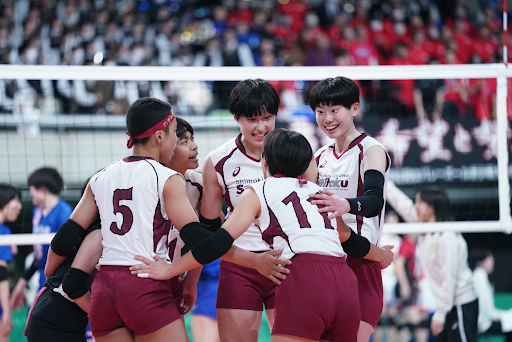
During Harukou 2025, many players excelled; specifically, the senior athletes born in 2006 were technically outstanding and dominant on court, earning a viral collective nickname: the “06 generation”. Reflecting this, some of these players qualified for the U19 Japan national team and are expected to represent Hinotori Nippon, the official Japanese volleyball team, in the future. Seniors like Miku Akimoto, Sae Omori, and Koyumi Fukumura brought their best to Harukou 2025; they hit every spike like javelin-like lightning from the sky and defended with blocks like a brick wall. These “06 generation” seniors made every game leading up to the final match unpredictable and full of hand-gripping excitement.
One player stood above all others and added a new dimension to the court: Yee Mon Myat, ace and captain of the Shimokitazawa Seitoku volleyball team. Japanese girl’s high school volleyball has been infamously known for its strict rules and conformity. Based on long traditions of discipline, almost all the players obediently follow their coach, practice the same routine, and even look similar: black hair neatly clipped into a short bob. In this system, there were hardly any foreign players, and none who held a position of leadership, as Foreigners’ appearances and values did not fit traditional styles. Yee Mon Myat was an immigrant, born to a political refugee family from Myanmar, a country where female representation in society remains limited. According to the United Nations Development Programme, Myanmar’s Gender Inequality Index is approximately 0.49, substantially higher than that of Japan (approximately 0.08). Conditions for Myanmar women reportedly deteriorated following the 2021 military coup. Yee Mon Myat’s presence as team captain of one of the leading girls’ teams thus defied the conventional norms of both Myanmar and Japanese volleyball.

Yararetara, Yarikaesu is Yee Mon Myat’s battle cry; if someone takes a point from her, she will take it right back. This fierce mindset is not typical of Japanese high school volleyball, where athletes remain calm, humble, and quiet. On court and during timeouts, Yee Mon Myat’s voice was powerful and larger than that of the coach. It was a voice not only for communication; she called for balls, set strategies, and encouraged teammates toward victory on the court. Her teammates’ trust was evident in the sets given to her throughout the match.
Harukou 2025 marked the beginning of individuality in Japanese high school volleyball. Many “06 generation” players stood out individually, but Yee Mon Myat, among them, remarkably broke through tradition and conformity. With her leadership, she added flavour and diversity to the high-stakes tournament. Harukou 2025 stands as a symbol of the evolution of Japanese high schools and volleyball.