

































In a survey conducted among ISSH’s high-school students, 73% reported viewing themselves as equal to or more inclined toward identifying as a STEM student. Through these numbers, we can see how, despite the school’s diverse curriculum, STEM electives consistently attract the largest number of students. Nevertheless, this is a trend that can be seen globally, and the question is not only what students choose, but why—and what this shift reveals about the pressures and opportunities shaping the ISSH community.
Elective trends within ISSH
ISSH offers the Advanced Placement (AP) program, which is a US-based curriculum that provides undergraduate university-level coursework for high school students. AP classes at ISSH are electives offered from Grade 11—with some exceptions available in Grade 10—allowing students to choose from a wide range of course subjects. Mathematics and Languages remain compulsory until Grade 11, and English is compulsory until Grade 12. There are currently 22 AP courses available at ISSH, encompassing a wide variety of electives ranging from the language arts to economics and the sciences. In addition to AP courses, ISSH also offers a variety of non-AP classes, including International Relations, Environmental Science, Food Technology, and 2D/3D Art and Design.
The trend we see within our school community, however, is that the distribution of students in these classes is uneven, with certain electives consistently attracting more students than others. Among the top seven most popular electives at ISSH, five were STEM-oriented, including both macroeconomics and microeconomics, as well as biology, chemistry, and physics. Whilst history and art electives are also highly popular, the STEM electives show the highest number of enrollment. In total, 133 students were enrolled in STEM electives, while 99 were in humanities electives.
This outlook aligns with students’ career interests at ISSH. In a survey conducted by the high-school student body, 58% of seniors are considering majoring in a STEM field. Additionally, when asked if the people around them view humanities electives as less important than STEM electives, 60% of the students agreed, highlighting the imbalance between how different disciplines are valued within ISSH.
There have also been changes to the school curriculum; notably, whereas students were once required to take pre-AP Biology before enrolling in AP Biology, the curriculum has now been condensed into a single one-year course starting this year. AP Biology has now become accessible to more students, as shown by the increasing number of students taking the course in the 25-26 school year.
On the other hand, extracurriculars at ISSH tend to be humanities oriented. Most extracurriculars, aside from sports, include the arts such as debate, choir, and orchestra. These opportunities allow students who mainly have STEM-based electives to explore their interests in the humanities and the arts outside of the classroom.
How an all-girls environment may be encouraging STEM popularity
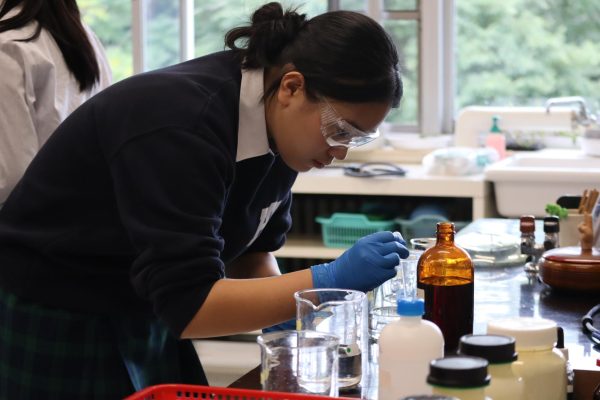
Although ISSH reflects the larger global decline in humanities enrollment, the reasons behind this shift may also be school-specific. In particular, the all-girls setting at ISSH could be contributing to the rising popularity of STEM electives among students.
Research on consequences of stereotypes has shown that negative gender stereotypes “contribute to gender disparities in STEM.” Take computer science, a STEM course rapidly increasing in popularity, as an example. Allison Master, an assistant professor in the Learning Sciences Department at the University of Houston, demonstrated in an experiment that the pervasive societal stereotype that women and girls are “less interested in computer science” can “reduce girls’ sense of belonging and motivation” in computer science studies. Typically, these gender stereotypes tend to be more heavily emphasized in co-ed environments.
AP Statistics and Calculus AB teacher Dr. Pomroy explained that when she was training to become a teacher, “there was a large disparity between the results girls attained at the higher level of mathematics in school and the numbers that went on to study mathematics and STEM related subjects in university.” She noted, however, that an all-girls school environment helps reduce this disparity. “Research suggested that girls performed better in a female-only environment while boys performed better in mixed sex schools,” said Dr. Pomroy. “I do notice that we have high numbers of students who want to take on higher level mathematics courses and who study sciences — particularly those that have previously been seen as more male subjects.”
Credit: Ms. Hayakawa
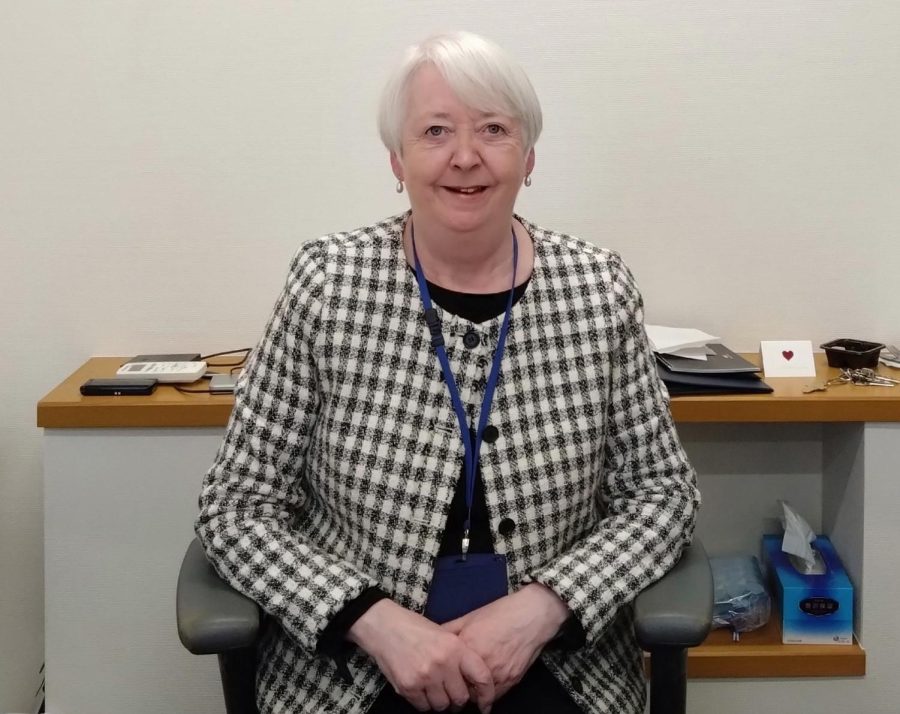
The strong promotion of STEM subjects amongst girls as well as within all-girls schools may also stem from students’ heightened awareness of the historical underrepresentation of women in certain fields. Ms. Sin, ISSH’s college guidance counselor, explains, “I think they have those exposures. It’s not like they don’t understand what glass ceilings are or that there’s bias towards girls. I think more aware of it, and that drives their motivations — ‘I want to take up space because I see that there is a gap; there is a need and I can do that.’”This awareness could be the very reason why girls are choosing STEM subjects in schools and pursuing them in higher education.
Skills acquired through a well-balanced curriculum
While STEM electives may be more popular among students, ISSH maintains a fair balance in its elective courses; the school currently offers 9 STEM electives and 9 humanities electives. Additionally, 60% of high school students believe that ISSH provides equal opportunities in both STEM and humanities.
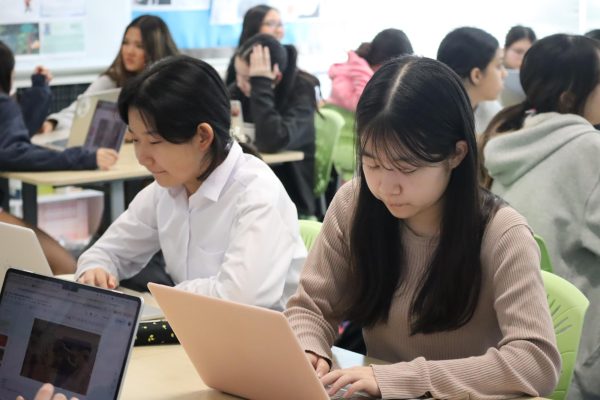
It is crucial to recognize the importance of a balance between STEM and Humanities as Mr. Eyre, head of ISSH’s English Language department, said “It seems some US universities are placing less value on humanities… There’s been much more of an emphasis on people thinking that if you study literature or philosophy that you’re doing damage to your career prospects.”
Credit: Ms. Hayakawa
He emphasized how in an age of vast amounts of information, English and literature is more important now than ever. “We’re also disadvantaged by that because it’s hard sometimes to know what is truthful and what is not or to what extent it is,” he said. “I think that English teaches those skills very well … to have critical thinking skills — to be able to assess, interpret, and evaluate the biases within sources.”
On the other hand, STEM subjects also play a role in developing these skills. Dr. Pomroy noted, “I think that there are different areas where the skills used in mathematics are applicable today, but I also think there may still be the idea of it as a gateway subject in certain areas.” She added that studying mathematics builds resilience and perseverance. “In this day and age, where anything can be posted onto the internet, and not all of it is true, a subject like statistics can also teach you to question and not take everything at face value.”
The idea that the humanities carry essential skills is also reaffirmed by the language department. Mr. Bessault, the AP French teacher at ISSH, says that language is a necessary part of education for anyone. “You need [languages], not because it’s a technical way of communicating, but because it teaches you a different way of thinking. And so when you know, when you are learning a new language, you can have two different points of view on anything.”
Mr. Delacharlery, head of the ISSH French Department, said that through languages, “you learn the culture, history, fun facts that actually always connect with bridges through other topics.” Studying different languages “helps you discover a new way to think and to view the world.”
How higher institutions are addressing the emerging imbalance
Teachers across humanities and STEM fields agree that both fields help nurture skillsets that are equally essential to navigating an increasingly complex and endlessly-evolving world.
Nevertheless, there is a significant imbalance between the two disciplines as schools worldwide are reporting a similar shift toward STEM-oriented curricula. According to US federal data, “the number of college students graduating with a humanities major has fallen for the eighth straight year to under 200,000 degrees in 2020.” Similarly, in the UK, a 2024 report found that there have been more students taking narrower subject combinations, resulting in a sharp decline in the number of students taking humanities and arts courses.
In order to prevent the imbalance of STEM and humanities skills within individuals, higher institutions have begun taking action to promote a more balanced and well-rounded skill set.
At the University of Western Australia, for instance, it is no longer compulsory for a student to hold a science degree to pursue a postgraduate course in Medicine. Recognizing that many doctors were poor in areas such as communication due to a sole focus on science, the university made the decision to remove the science degree prerequisite in hopes of diversifying students’ skillsets.
Mr. Durston, a Chemistry teacher and a graduate from Australia, reinforces this idea, pointing out that when a group of people with diverse sets of skills come together, it changes the dynamics. “We tend to like to associate with people who are similar to us, and that can create the bubble effect where we are constantly getting reinforced by the people around us, narrowing our minds. But when we have that diversity, it can challenge our perspectives and views and open up the bubble to fresh ideas and new ways of thinking,” said Mr. Durston.
How ISSH aims to maintain a balanced curriculum
Similar to these universities, ISSH is also taking action to maintain a balance between STEM and humanities courses in various ways. For one, English is a mandatory subject for students in all grade levels. While Grade 11/12 students have the option to choose between Standard English and Advanced Placement English Composition, students are not allowed to drop the subject completely.
The head of the English department at ISSH, Mr. Eyre comments on the English curriculum offered in high school. “By having brilliant AP courses in G11 and 12 we also have that added challenge, but then there’s also the G11 and 12 English courses which are interesting and designed to build skills but also maintain interest,” Mr. Eyre said. In doing so, students who don’t feel ready to take Advanced Placement English courses can still develop essential humanities skills through the standard English courses.
In addition to the mandatory English course, Values is also a mandatory requirement at ISSH. These Values courses—some of which include Moral Decision Making, Theory of Knowledge, and Refugees & Human Rights—focus on developing students’ ways of thinking, teaching students how to apply their own moral values to world issues, and encourage students to express their opinions. In this way, even students who chose all STEM-based electives will have another source of exposure to the humanities in addition to the mandatory English classes.
Credit: Linda L.
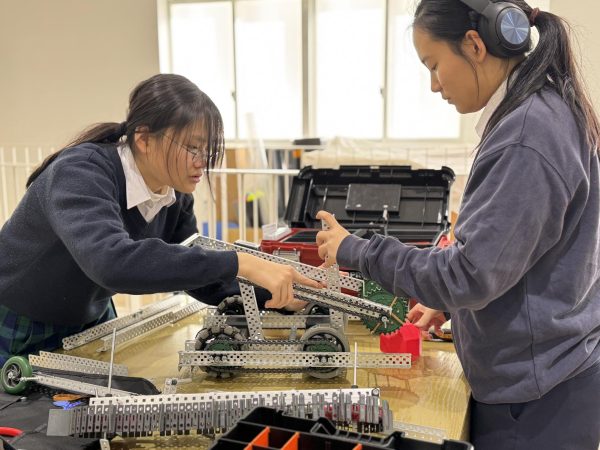
Beyond Values and core electives, ISSH also maintains a balance between STEM and humanities through its wide range of Options courses and extracurricular activities. These options — including journalism, photography, filmmaking, jazz dance, wheel throwing, yearbook, speech and drama, vocal options, and robotics — offer students opportunities to engage with humanities and arts-oriented skills and STEM-focused skills outside their academic schedules. This variety ensures that even if students lean more heavily towards either STEM or humanities electives in their academic coursework, they are given the chance to broaden their interests outside of their core electives.
University and Beyond
While ISSH’s curriculum maintains some balance, once students progress to university, they become part of a much larger trajectory, as universities are increasingly channeling their investments into STEM fields.
Ms. Sin states that shifts partially influence the degrees offered by universities in labour markets. Currently, the shift towards STEM is influenced by the rapid advances in digital technology, artificial intelligence, and engineering. In fact, a World Economic Forum analysis of 1,000 leading global employers, collectively representing more than 14 million workers, reports that “broadening digital access” is one of the “most transformative” factors influencing the shift in job markets toward STEM fields.
Based on these predictions, universities are already distributing more budget to the majors required for the trending labor markets. The University of New South Wales in Australia, following a record high $30 million donation, is planning to build new residential colleges “dedicated to women studying science, technology, engineering and mathematics (STEM).” Princeton University opened three major new buildings this fall, of which two are dedicated to chemical and bioengineering research.
Many students also feel that their future prospects influence their choice between STEM and humanities majors. Of the ISSH students whose focus was more on STEM subjects, 46% claimed that both financial stability and job opportunities were the main factors motivating them to pursue STEM.
“We are expecting more skilled workers in the next five, ten years and a lot of colleges will take that into consideration when they look into their majors,” said Ms. Sin. “So we will see shifts where more is being put in STEM because there’s a lot of growth there.”
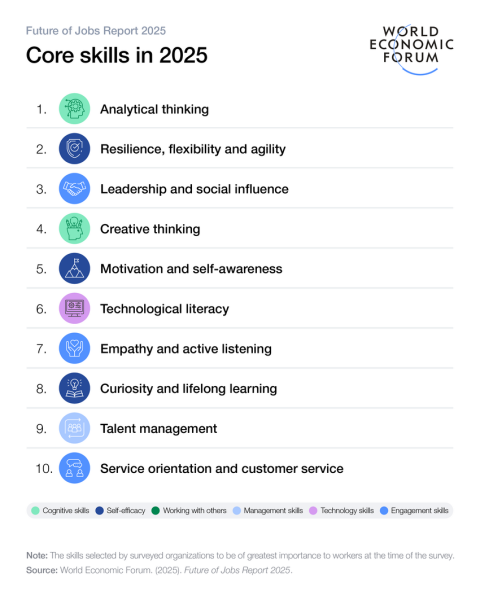
However, according to the World Economic Forum, the top ten core skills needed in 2025 involve a balanced combination of skills cultivated through both STEM and humanities courses.
Nearly all careers—whether in engineering, medicine, and mathematics, or in sociology, philosophy, and social studies—require commitment, perseverance, communication, and critical thinking. While STEM’s experiments and rigorous curricula develop our patience, and resilience, it is through the study of humanities that teach us how to work with others and formulate our own opinions.
In an all-girls institution like ISSH, it is understandable that students may feel encouraged to pursue STEM fields in which women have historically been underrepresented. Nevertheless, this could risk pressuring the balance between the diverse range of courses we have here at ISSH. While supporting women in STEM is essential, it is equally crucial not to diminish the value of humanities courses. Ultimately, the goal should be to maintain a healthy balance—one that allows students to benefit from the strengths of both STEM and the humanities.